Why Your Woodworking Project Doesn't Fit: 9 Common Plan Mistakes
When parts don't line up, the cause is usually in the plan or in a habit, not in your hands. Here are the nine we see most often.
You followed the plan, measured twice and the project still came out with gaps, a wobble or a shelf that won't go in. Almost always, the cause is one of a handful of known mistakes. Some are in the plan before you touch a board; some are shop habits that add a little error at every cut.
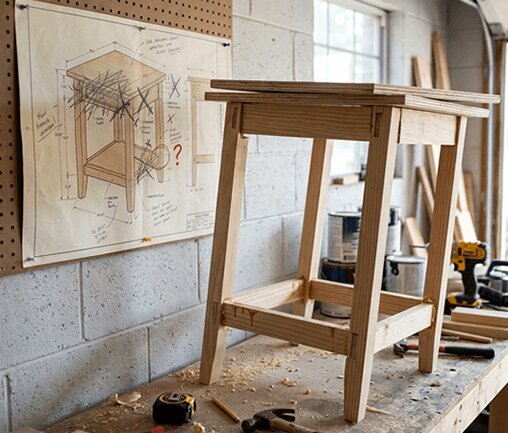
1. The plan uses nominal lumber sizes
A 2x4 is 1½ x 3½ inches and a 1x board is ¾ inch thick. A plan drawn with 2 and 1 instead of 1½ and ¾ will be wrong everywhere boards stack or butt together. On a cabinet with two 1x sides, that is ½ inch of error before you start. See our nominal vs. actual lumber size chart.
2. The cut list and the drawing disagree
Many plans were drawn once and the cut list typed separately. Add up the parts along one dimension and compare the total with the overall size on the drawing. If they don't match, one of them is wrong, and you want to find out at the kitchen table, not at the saw.
3. Forgetting the saw kerf
The blade turns a strip of wood into sawdust. On many circular saw and miter saw blades that strip is about 1/8 inch wide; thin-kerf blades remove a little less. If you mark several parts end to end on one board and cut on the lines, every part after the first comes out short by a kerf. Measure and mark one part at a time, from a fresh square end.
4. Measuring from a different reference each time
Measuring each part from the end of the last cut piece lets small errors stack up. Use one reference: a stop block on the saw for repeat parts, or one story stick marked with every length. Cut matching parts (legs, rails, shelves) at the same time with the same setup.
5. Trusting the factory end
The ends of a board from the yard are rarely square and often rough or split. Trim a little off one end with a square cut, then measure from that end.
6. Crooked, cupped or twisted boards
A board that is bowed along its length, cupped across its width or twisted will pull a frame out of square no matter how carefully you cut. Sight down every board at the store and pick the straightest ones. Cut long crooked boards into shorter parts, where the bend matters less.
7. Wet lumber that shrinks after you build
Construction lumber stamped dry can still hold up to 19% moisture, and treated lumber is often wetter. As it dries to the moisture level of your area it shrinks across its width, and joints open up weeks later. Let lumber sit in the space where the project will live, and check the typical outdoor moisture levels in our wood moisture by state pages.
8. No room for wood movement
Wood keeps swelling and shrinking across the grain with the seasons. Using the Wood Handbook's shrinkage coefficient for loblolly pine (Table 13-5), a flat-sawn tabletop 24 inches wide changes width by about ⅜ inch between 6% and 12% moisture content. A top screwed down tight at every point can split or buckle. Plans should fasten wide tops with slotted holes or tabletop fasteners that let the wood move.
9. Skipping the dry fit
Glue and screws make mistakes permanent. Assemble the project with clamps first, check it for square by measuring the diagonals, and only then glue and drive the screws.
Symptom, likely cause, fix
| Symptom | Likely cause | Fix |
|---|---|---|
| Shelves or rails short | Nominal sizes in the plan, or kerf ignored | Measure the opening and cut parts to fit |
| Frame won't sit square | Crooked boards, or uneven matching parts | Check diagonals; recut the odd part |
| Project rocks on the floor | Legs not cut as a matched set | Cut legs together with a stop block |
| Gaps open up weeks later | Wet lumber drying out | Acclimate lumber before building |
| Top splits or bows | No room for wood movement | Slotted holes or tabletop fasteners |
| Overall size wrong | Cut list doesn't match the drawing | Total the parts before cutting |
Is it the plan or is it you?
When a project doesn't fit, it is tempting to blame your own cutting. Before you do, check the plan. Measure the parts you cut against the cut list: if they match the list and the project still doesn't go together, the plan is wrong, not your hands. Then look for the pattern. Errors of ½ inch, 1 inch or 1½ inches that repeat wherever boards stack usually mean nominal sizes. Errors of about ⅛ inch per cut usually mean the kerf was ignored. Random small errors usually mean a shop habit, like measuring from different references or a square that isn't square.
A plan that someone actually built from, with photos of the finished piece, has had most of these problems found and fixed already. A plan that was only drawn has not.
Check a plan before you buy lumber
- Dimensions use actual board sizes (¾ and 1½ inches, not 1 and 2).
- The parts along each dimension add up to the overall size.
- There is an exploded drawing showing how every part joins.
- The cut list names the board each part comes from.
- Screws are listed with their lengths.
- Photos show the project actually built from that plan.
Think you can spot a bad plan? Try our 30-second challenge: Can You Spot the Mistake in This Woodworking Plan?