Basic Woodworking Tools for Beginners: What You Need First (and What Can Wait)
Buy tools for the project in front of you, not for the shop you imagine. Here is the short list, and when each tool earns its place.
The fastest way to spend too much on woodworking is to buy a shop before building anything. Most beginner projects need a saw, a drill, a square and a tape measure. Everything else can wait until a project calls for it, and by then you will know what you actually need.
Measuring and marking
Tape measure. A 16- or 25-foot tape covers furniture and yard projects. The hook on the end slides slightly on purpose, so it reads correctly for both inside and outside measurements.
Speed square. A triangular square that marks square and angled lines and doubles as a fence to guide a circular saw. If you buy one measuring tool besides the tape, buy this one.
Combination square. Checks that an edge or a cut is square, marks lines parallel to an edge and measures depth. Useful once projects get more exact.
A sharp pencil. A thick carpenter's line can be 1/16 inch wide. Mark with a sharp pencil and cut on the waste side of the line.
Cutting
Circular saw. The most versatile first saw. It crosscuts boards, rips long cuts and cuts plywood sheets that won't fit on a bench.
Miter saw. Makes fast, square, repeatable crosscuts and angle cuts. Worth adding if you are cutting lots of parts to length.
Jigsaw. Cuts curves, like the back of an Adirondack chair or the arch on a planter.
Hand saw. Quiet and slow, fine for small projects and a good choice for working near kids, when the adult is the one sawing.
Drilling and driving
Drill/driver. Drills holes and drives screws. Add a set of drill bits, a countersink bit (so screw heads sit flush) and a few driver bits that match your screws. An impact driver drives long screws more easily, but a drill/driver does the job on beginner projects.
Holding the work
Clamps. Two to four bar or F-style clamps to start. They hold a board still while you cut, hold parts together while you drill, and act as a second pair of hands while glue dries.
Smoothing
Sanding block and sandpaper. Enough for small projects. A random-orbit sander speeds up anything bigger. Work from a coarser grit to a finer one, and sand edges people will touch.
Safety gear (buy this first)
- Safety glasses you will actually wear.
- Hearing protection: earmuffs or plugs for every saw and sander.
- A dust mask or respirator for sanding and sawing.
- A first aid kit in the shop.
The beginner tool list at a glance
| Tool | What it's for | Buy it |
|---|---|---|
| Tape measure, speed square, pencil | Measuring and marking | Before the first project |
| Circular saw or hand saw | Cutting boards to length | Before the first project |
| Drill/driver and bits | Pilot holes and screws | Before the first project |
| Safety glasses, hearing protection | Protecting eyes and ears | Before the first project |
| Clamps (2 to 4) | Holding work and glue-ups | First or second project |
| Sander | Smoothing faster | When sanding by hand slows you down |
| Jigsaw | Curves | When a project has curves |
| Miter saw | Fast repeat crosscuts | When you cut many parts to length |
| Combination square | Checking square, marking parallel lines | When joints need to be tight |
Corded or cordless?
Both work for beginner projects. Cordless tools are easier to carry to the backyard and have no cord to trip over or cut through. Corded tools never run out of charge in the middle of a cut and are a good fit for a saw that stays in one place, like a miter saw on a bench. Many people end up with a cordless drill/driver and a corded saw. Whatever you choose, read the manual's safety section and learn where the guard, the lock-off switch and the blade-change lock are before the first cut.
Setting up a small space
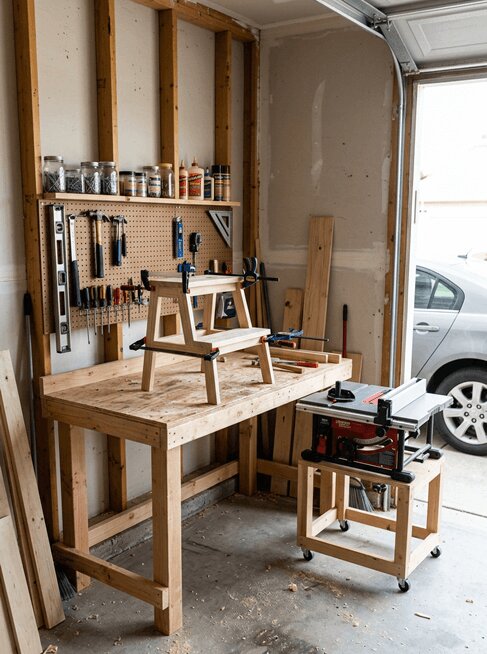
A one-car garage or the corner of a basement is enough for every project in our beginner list. What matters most is a solid, flat surface at a comfortable height, good light over it and a way to hold the work down. A pair of sawhorses with a sheet of plywood on top makes a fine first bench and folds away. Hang the tools you use every session on the wall within reach, keep the floor clear of offcuts so nothing rolls underfoot, and make sure the outlet you use can handle a saw without tripping. When the space is tight, build outdoors on a dry day and store the parts inside.
What can wait
Table saw. Powerful and useful, and the tool in a hobby shop that most rewards proper instruction. Learn it from someone experienced, after you've built a few projects with simpler saws.
Router, planer and jointer. For shaping edges, thicknessing rough lumber and straightening boards. Useful later; not needed for projects built from stock lumber.
Specialty jigs. Buy them when a specific project needs one.
A buying checklist
- Buy for the next project, not for every project you might build.
- If you go cordless, stay with one battery system so batteries swap between tools.
- Check a square before you trust it: draw a line along it, flip it over, draw again. The lines should match.
- A good blade matters more than the saw. Replace dull blades instead of forcing the cut.
- Read the manual for every power tool, especially the safety section.
Ready to use them? We picked seven weekend projects you can build with a saw, a drill and a square.